
A well-maintained garden tool is a different object from a neglected one. The blade of a spade that has been cleaned after every use, dried and lightly oiled before storage, slides through soil with noticeably less resistance. A pair of secateurs that has been regularly sharpened cuts cleanly without crushing, which directly affects how quickly the plant recovers from pruning. The economics are straightforward: good tools are expensive, and maintenance extends their useful life by a decade or more.
The following covers the core maintenance procedures for the tools most commonly found in Czech gardens, organised by frequency and by tool type.
After Every Use: Basic Cleaning
Removing Soil from Metal Blades
The standard approach is to scrape bulk soil off with a rigid brush or an old pointed stick before it dries. Dried clay — particularly the heavy Moravian variety — bonds firmly to steel and requires considerably more effort to remove than fresh mud. A wooden scraper avoids scratching the blade surface.
After scraping, rinse the blade with water (a bucket or low-pressure hose is sufficient) and dry with an old cloth or leave in a ventilated area for no more than an hour. Leaving wet steel overnight accelerates surface rust, which, while usually superficial, makes the tool less pleasant to use and eventually pits the cutting surface.
Secateurs and Loppers
Pruning tools that have been used on diseased plants should be wiped with a cloth dampened in rubbing alcohol (70% isopropyl) or a diluted bleach solution (one part bleach to nine parts water) before moving to the next plant. This is especially relevant when working with fire blight on pear trees — a bacterial disease that spreads readily through contaminated cutting tools.

Monthly or Mid-Season: Sharpening
Spades and Hoes
A sharp spade requires less physical effort and enters compacted soil more cleanly. The bevel is on the front face of the blade (the face pointing away from you when you push it in). Maintain this bevel with a flat file, working in strokes from the centre outward, keeping the file at the existing angle — typically 25 to 35 degrees. Five to ten passes are usually sufficient to restore a working edge.
Hoes benefit from the same treatment. A sharp hoe skims weed roots cleanly at the surface; a dull one drags and pushes soil, missing the cut. Sharpen after approximately every four hours of use, or whenever the blade visibly deflects from weeds rather than cutting through them.
Secateurs
Bypass secateurs have a single bevel on the upper (cutting) blade. Sharpen this blade only — the lower blade (the counter blade) has a flat face that should remain flat. Use a diamond whetstone or a small whetstone specifically shaped for pruning tools. Work in strokes following the bevel angle, removing the burr on the flat side with a single flat pass.
Signs that secateurs need sharpening: the blades start to crush rather than cut cleanly, a visible gap appears when the blades are closed, or it takes noticeably more hand pressure than usual to cut through a live stem.
Seasonally: Lubrication and Deeper Maintenance
Moving Parts on Secateurs and Loppers
The pivot bolt on secateurs should be lubricated twice per season with a light machine oil or specialist tool oil. Over-tightening or under-tightening this bolt affects blade alignment. The gap between closed blades should be consistent from tip to heel — if the blades cross before the tips meet, the tool is properly adjusted. A spray of WD-40 or similar displaces water after wet-weather use, but it is not a substitute for proper oil on the pivot.
Handles
Ash and hickory handles — the most common materials in quality Czech and German tools — absorb moisture when wet and dry out in summer heat. Both processes cause cracking and, eventually, splitting. An annual treatment with raw linseed oil prevents this. Apply with a cloth, allow to soak in for 30 minutes, then wipe off the excess. Two or three coats in the first season, then one coat per year thereafter, is sufficient.
Avoid boiled linseed oil, which leaves a sticky film. Raw linseed oil soaks in cleanly. For varnished handles — common on cheaper tools — light sanding and a coat of teak oil works reasonably well, though replacing the handle entirely with an ash handle from a hardware store is often the better long-term approach.
Wheelbarrow Tyres
Pneumatic tyres on wheelbarrows lose pressure slowly even without punctures. Check tyre pressure at the start of each season and inflate to the manufacturer recommendation (usually printed on the tyre sidewall, typically 1.5–2.5 bar for garden wheelbarrows). A soft tyre increases rolling resistance and strains the wheel bearings.
End-of-Season Preparation
Steel Blades
Before winter storage, clean all steel surfaces thoroughly, dry them, and apply a thin protective coating. Options in increasing order of protection: a rag wiped in vegetable oil, petroleum jelly applied by hand, a commercial spray preservative (such as ACF-50 or similar), or a light wiping of 3-in-1 oil. Any of these prevents surface oxidation through the damp Czech winter.
Sprayers and Hosepipes
Empty all water from garden hoses and knapsack sprayers before the first freeze. Residual water expands when frozen and cracks plastic fittings, hose connectors and pump seals. Roll hoses loosely — tight coiling creates creases that weaken the material — and store horizontally indoors or in an unheated but dry outbuilding.
Storage Arrangement
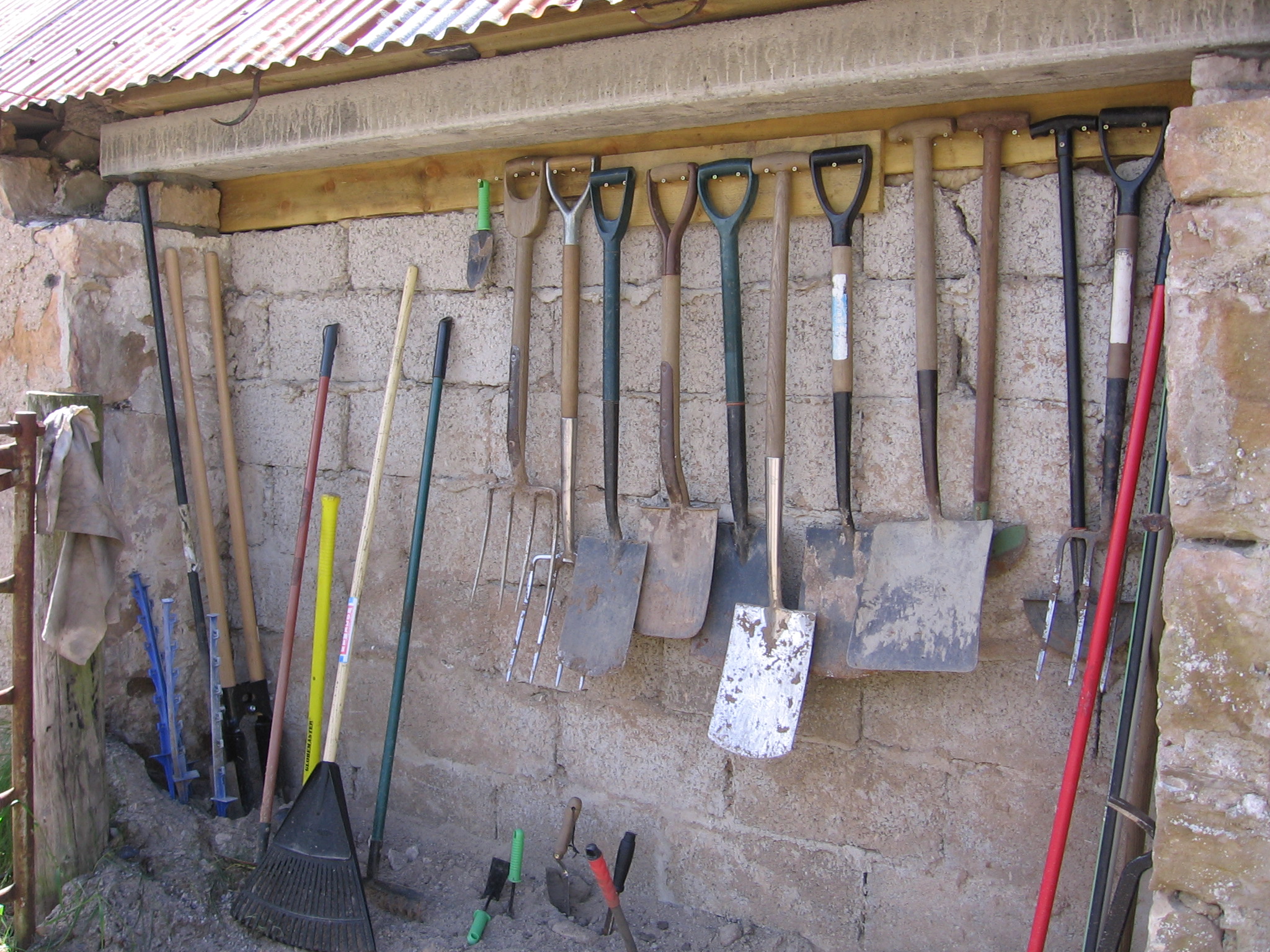
Tools stored upright with heads down — leaning against a wall — develop handle rot at the base more quickly than those hung horizontally or with the blade up. Wall-mounted hooks or a simple wooden rack with drilled holes for handles keeps tools off the ground and allows air circulation around both blade and handle.
Replacement Indicators
Some deterioration is worth repairing; some indicates a tool has reached the end of its practical life. Replace rather than repair when:
- A wooden handle has cracked along the grain through the socket area — this is a structural failure, not a cosmetic issue.
- A spade blade has a crack propagating from an impact point, or has bent and been straightened more than once.
- Secateur blades have been sharpened to the point where the bevel has been removed and the blade is uniformly thin — they will no longer hold an edge.
- Rust has pitted rather than merely discoloured the cutting surface — pitting creates a texture that holds soil and makes sharpening harder.
Quality replacement handles for most standard Czech and German spades and forks are available from agricultural supply stores (zemědělské potřeby) and from some hardware chains at reasonable cost, and fitting them is straightforward for anyone comfortable with basic hand tools.
Related reading: Essential Garden Tools for Czech Seasons and Seasonal Garden Care Guide for Czech Republic.
Last updated: 1 May 2026 · RHS Tool Maintenance Guide