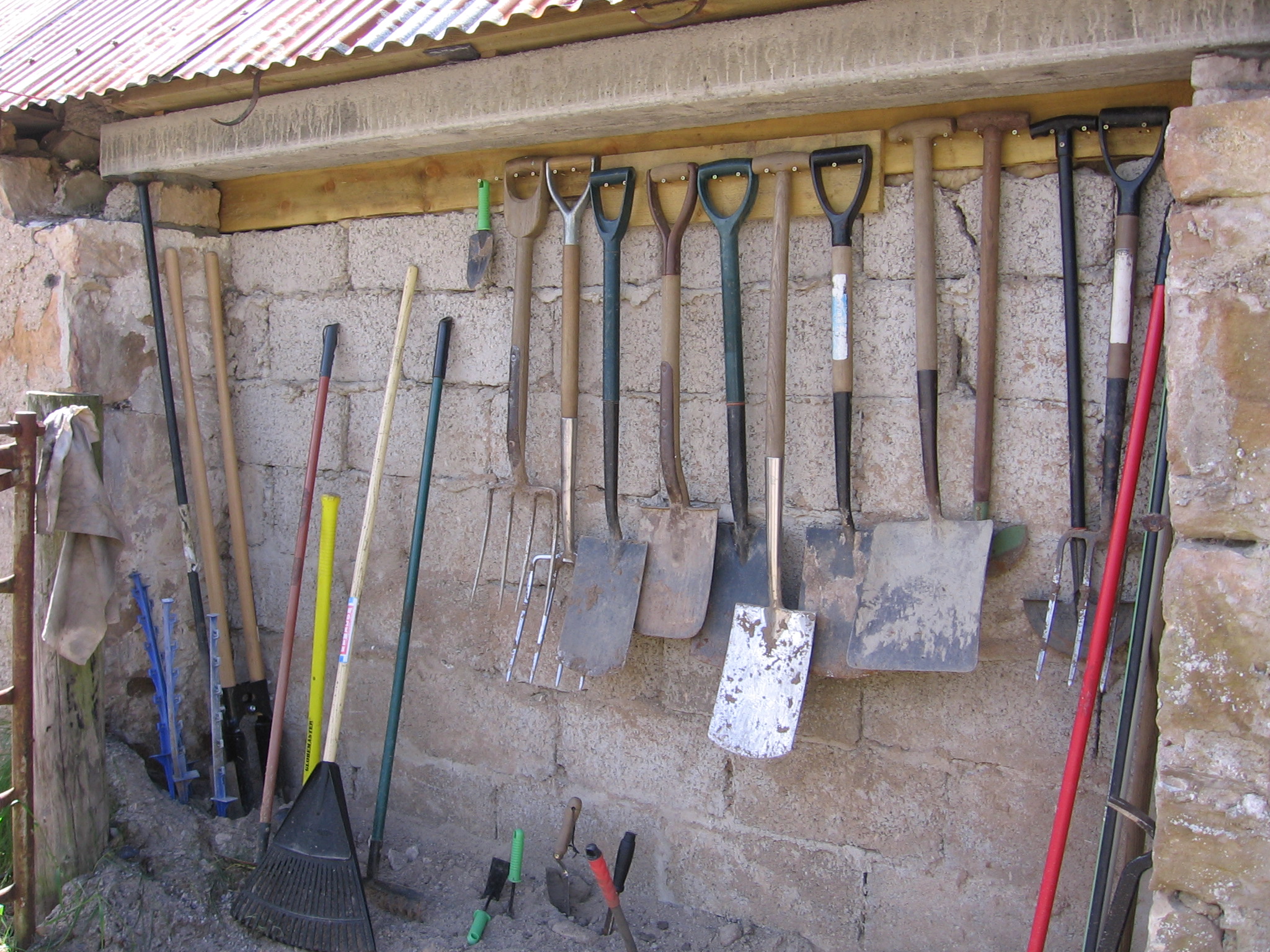
Czech gardeners deal with a reasonably demanding climate. Winters are cold enough to freeze shallow-rooted perennials and crack clay soil. Spring arrives abruptly, often dumping a month of rain in two weeks. Summer can swing between drought and thunderstorms. Autumn brings the important window for bulb planting and soil preparation before the ground stiffens.
Each of these periods calls for specific tasks, and each task has at least one tool that makes it significantly easier. The following categories cover the full range of what a well-equipped Czech garden requires, without padding the list with tools that rarely leave the shelf.
Digging and Soil Preparation
Digging Spade
The flat-bladed digging spade is the single most-used tool in most Czech gardens. It cuts cleanly through turf, lifts clods, and edges beds. A T-bar or D-ring handle is a matter of personal preference, but the blade should be forged steel rather than pressed — forged tools hold their edge significantly longer and survive the rocky subsoil found in parts of Bohemia without bending.
Blade length matters for leverage. A full-size blade (about 28 cm tall) moves more soil per push, while a border spade (20 cm) fits between established plants without damage. Most households benefit from owning both.
Garden Fork
Where a spade cuts, a fork breaks up clods and aerates. Heavy Moravian clay, in particular, responds better to fork-work before planting: pressing a spade into waterlogged clay compacts the structure further, while tines allow water to drain between passes. Forks with four square tines handle heavy soil better than those with flat tines, which are better suited to lifting root vegetables at harvest.

Hand Trowel and Hand Fork
For planting bulbs, transplanting seedlings, and weeding between established perennials, a hand trowel and a small hand fork are indispensable. Look for a one-piece forged stainless steel design — the joint between blade and handle is where cheaper tools fail first, usually during the spring rush when the ground is still slightly frozen near the surface.
Cutting and Pruning
Bypass Secateurs
Czech orchards and ornamental gardens alike depend on clean cuts. Bypass secateurs (where one blade passes the other like scissors) produce a sharper wound edge than anvil types, which crush the stem against a flat plate. Crushed tissue heals slowly and admits pathogens more readily — a real concern with fungal disease on fruit trees, which are common in Czech gardens.

A good pair of secateurs should handle stems up to 15 mm in diameter comfortably. Beyond that, a folding pruning saw or loppers are the correct choice, not a forced cut with secateurs that will damage the tool and leave a ragged wound.
Loppers
Long-handled loppers extend reach and multiply leverage for branches between 15 and 35 mm. Ratchet loppers reduce effort by roughly 30% compared with standard straight-cut versions — useful for elderly gardeners or those working extensively with established apple trees.
Garden Shears and Hedge Trimmers
Box hedges, hornbeam, and privet are common in Czech gardens, particularly around older properties. Manual shears give better control for fine topiary. For longer runs of hedging, electric or battery-powered hedge trimmers reduce fatigue considerably; cordless models are now practical enough for most domestic hedges, though a corded model remains more consistent for longer sessions.
Watering
Garden Hose and Reel
Czech summers are drier than the Atlantic climate many gardening guides assume. July and August can go three or four weeks without meaningful rainfall in parts of South Moravia. A garden hose with adjustable spray head covers most watering tasks; a self-retracting reel prevents the kinking and tangling that shortens hose life considerably.

Note that outdoor taps in Czech properties should ideally be frost-proof designs (draining internally when the handle is turned off), or at minimum isolated indoors with the external pipe drained before the first freeze, typically late October or early November.
Watering Can
A metal watering can with a long rose attachment remains useful for seedlings and greenhouse work where a hose would be too forceful. Plastic cans are lighter but crack in UV over a few seasons; galvanised steel lasts considerably longer in outdoor storage conditions.
Ground Maintenance
Rake
Two rakes cover most situations: a flat steel rake for levelling soil and breaking the crust after rain, and a fan rake (leaf rake) for gathering autumn debris. The Czech autumn drop of linden, oak and maple leaves is heavy from September through November; a wide fan rake moves more volume per pass and reduces the work considerably.
Hoe
A Dutch hoe (or push hoe) is the standard weed control tool between vegetable rows. It cuts the roots of annual weeds just below the surface on the forward push. For established perennial weeds — dandelion, bindweed, couch grass — a draw hoe with a narrower head provides more precision. Neither replaces the need to remove root fragments entirely, but both reduce the population substantially between diggings.
Transporting and Composting
Wheelbarrow
A single-wheel steel wheelbarrow with a capacity of 80–100 litres handles most garden tasks without being unwieldy. Pneumatic tyres cope better with uneven ground than solid rubber; a flat tyre, however, requires a pump or replacement — worth checking before purchase whether the design allows easy tyre removal.

Compost Bin
Czech legislation (zákon č. 541/2020 Sb.) encourages separate collection of biowaste, and many municipalities provide composting bins at reduced cost. For larger gardens, a sectioned composter — two or three bays — allows one section to mature while the others receive fresh material. The combination of a composting fork (long-handled, with five flat tines) and a compost bin constitutes a self-contained soil amendment system that reduces the need for bought inputs significantly.

Storage and Maintenance
Even the best tools deteriorate quickly in damp conditions. A dry, ventilated shed with wall-mounted hooks keeps tools off the ground and prevents handle rot. Steel heads benefit from a thin coating of linseed oil or petroleum jelly before winter storage; wooden handles should be wiped with raw linseed oil once or twice a year to prevent splitting.
Related reading: How to Maintain Garden Tools Properly and Seasonal Garden Care Guide for Czech Republic.
Last updated: 1 May 2026 · RHS Tools Reference